
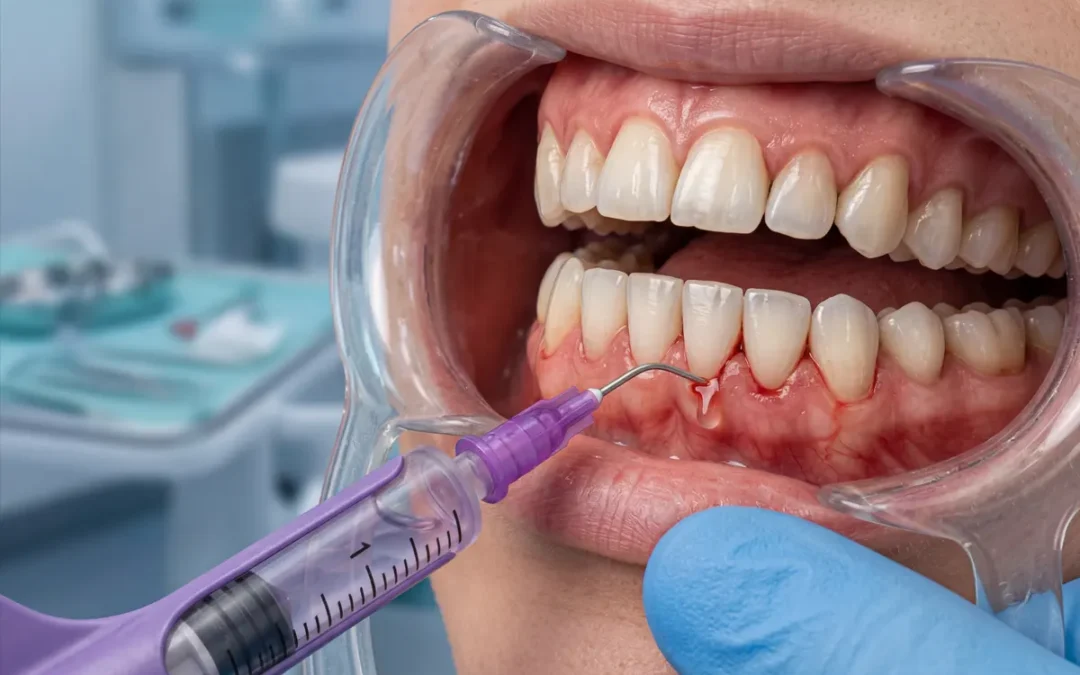
thus improving clinical outcomes.
The role of irrigants in periodontal therapy
Effective periodontal treatment relies on more than mechanical debridement alone. Scaling and root planing remain the foundation of care, but complete disruption of pathogenic biofilm—particularly within deep periodontal pockets and complex root anatomies—cannot always be achieved with instruments alone¹.
This is where ‘chemo-mechanical’ adjuncts play a vital role. However, it is important to distinguish between two users: dental professionals and dental patients:
- Dental Professionals, used chairside by clinicians during active treatment
- Patient-directed irrigants, used at home to support ongoing care, typically post treatment
Professional irrigants are delivered directly into periodontal pockets during treatment. Their purpose is to reduce oral detritus around gum pockets and tooth surfaces: this is made up of both physical material like food particles, dead cells, and tartar, as well as organic material like biofilm. This debridement creates a cleaner environment to support healing following instrumentation². These solutions must act rapidly, penetrate effectively, and be safe for direct contact with exposed periodontal tissues.
In contrast, home-use irrigants are designed for repeated, longer-term use by patients post treatment. Their role is supportive—helping to control plaque regrowth, maintain reductions in inflammation, and prolong the benefits of professional therapy. For these successful treatment outcomes, patient compliance, tolerability, and safety become just as important as antimicrobial performance³.
Historically, a limited number of agents have been used across both settings, despite the differing demands of each. This has contributed to ongoing challenges in achieving optimal outcomes.
Chlorhexidine: half a century of dominance
Few compounds have shaped periodontal therapy as profoundly as chlorhexidine (CHX). First introduced in the 1950s, it evolved from a general antiseptic into the most widely used chemical plaque control agent in dentistry³. For decades, it has been considered the gold standard for both professional and post treatment use.
Its success is largely attributed to its substantivity—the ability to bind to oral tissues and release slowly over time—combined with broad-spectrum antimicrobial activity against periodontal pathogens³. This made chlorhexidine particularly effective as a mouthwash for controlling plaque and gingivitis, as well as a useful adjunct in post-surgical care⁴.
Over time, it has been incorporated into multiple delivery formats, including rinses, gels, varnishes, and locally delivered systems.
The problem with the gold standard
Despite its long-standing status, chlorhexidine presents several limitations—many of which are amplified when considering the distinction between professional and home use.
Staining and patient compliance
Extrinsic tooth staining affects a significant proportion of users and is a major drawback in home-use scenarios⁵. While less relevant during short-term professional application, staining becomes a key barrier to patient adherence when chlorhexidine is prescribed for ongoing use. Increased calculus formation further compounds this issue⁶.
Reduced efficacy in biofilm
In the professional setting, irrigants must act effectively within established subgingival biofilm. Evidence indicates that chlorhexidine has limited penetration into mature biofilm structures, reducing its effectiveness during active periodontal treatment².
Biocompatibility concerns
For chairside use, biocompatibility is critical. Chlorhexidine has demonstrated cytotoxic effects on fibroblasts and other cells essential for periodontal healing⁷. This raises concerns about its suitability as an irrigant in regenerative or healing-focused therapies.
Safety profile
Although rare, reports of chlorhexidine-associated anaphylaxis have increased awareness of its systemic safety limitations⁷. While the absolute risk is low, this is a consideration for both professional application and unsupervised home use.
Taken together, these limitations suggest that while chlorhexidine has been highly effective historically, it does not fully meet the evolving requirements of either professional irrigants or patient-friendly home care solutions.
What defines an ideal periodontal irrigant?
Given the dual role of irrigants in clinical and home settings, the ideal solution must satisfy a broad set of criteria. Based on the literature, key properties include⁸⁻⁹:
- Broad-spectrum antimicrobial activity against periodontal pathogens
- Efficacy against structured biofilm, particularly in subgingival environments
- Excellent biocompatibility, ensuring no cytotoxic effects on host tissues
- Support for healing and regeneration, especially following instrumentation
- No staining, taste disturbance, or calculus-promoting effects
- Strong safety profile, with no toxicity or risk of allergic reactions
- Suitability for both professional and repeated home use
- No contribution to antimicrobial resistance
In practice, very few agents meet all of these requirements. Many traditional irrigants are either too aggressive for safe home use or insufficiently effective in the clinical environment.
Introducing PerioWize: a new generation irrigant
PerioWize, developed by Tec-Safe as a class 3 medical device, has been designed to bridge the gap between professional efficacy and patient-friendly safety. Its active ingredient, stabilised hypochlorous acid (HOCl), offers a fundamentally different approach to preventative and reactive periodontal dental treatment.
HOCl is a molecule naturally produced by neutrophils as part of the body’s immune defence system. It is highly effective at neutralising bacteria, fungi, and viruses, while remaining inherently compatible with human tissues¹⁰.
This unique profile makes PerioWize suitable for both key applications in periodontal care:
As a professional irrigant:
- Rapid antimicrobial action during scaling and root planing
- Effective disruption of biofilm within periodontal pockets
- Safe interaction with exposed tissues, supporting healing
As a patient-directed adjunct:
- No staining or taste disturbance, improving compliance
- Safe for repeated use over extended periods
- Supports maintenance of periodontal health between appointments
By combining these characteristics, PerioWize aligns closely with the ideal irrigant profile—something traditional agents have struggled to achieve.
Why PerioWize’s active ingredient represents the future
Hypochlorous acid offers several advantages that directly address the shortcomings of legacy irrigants. Its oxidative mechanism targets multiple microbial structures simultaneously, making resistance unlikely and ensuring broad-spectrum efficacy¹¹.
Importantly, HOCl has demonstrated effectiveness against biofilm while remaining non-cytotoxic to host tissues—an essential balance in periodontal therapy¹⁰. Unlike chlorhexidine, it does not interfere with fibroblast activity and may support the healing environment.
From a patient perspective, the benefits are equally significant:
- No cosmetic compromise
- No alteration in taste
- No documented risk of severe allergic reactions when properly formulated
- Flexibility for both clinical and home use
This dual applicability represents a major step forward—eliminating the traditional trade-off between clinical strength and patient tolerability.
Conclusion
The distinction between professional irrigants and home-use mouthwashes is central to modern periodontal care. Each plays a different but complementary role, and both demand solutions that are effective, safe, and practical.
Chlorhexidine has served as the gold standard across both domains for decades. However, its limitations—particularly in biofilm efficacy, biocompatibility, and patient acceptability—are increasingly evident.
PerioWize, powered by hypochlorous acid, represents a new generation of irrigant capable of meeting the demands of both clinical and home use. By combining antimicrobial efficacy with exceptional safety and patient-friendly characteristics, it offers a more complete solution for contemporary periodontal therapy.
As dentistry continues to evolve, so too must the tools it relies on. PerioWize may well define the next gold standard.
References
- Cobb CM. Non-surgical pocket therapy: mechanical. Ann Periodontol. 1996.
- Shiloah J, Hovious LA. Subgingival irrigation in periodontal therapy. J Periodontol. 1993.
- Jones CG. Chlorhexidine: is it still the gold standard? Periodontol 2000. 1997.
- James P et al. Chlorhexidine mouthrinse as adjunctive treatment. Cochrane Database Syst Rev. 2017.
- Addy M, Moran J. Mechanisms of chlorhexidine staining. J Clin Periodontol. 1995.
- Flotra L et al. Side effects of chlorhexidine. Scand J Dent Res. 1971.
- Pemberton MN et al. Adverse reactions to chlorhexidine. Br Dent J. 2012.
- Slots J. Selection of antimicrobial agents in periodontal therapy. J Periodontal Res. 2002.
- Herrera D et al. Adjunctive antimicrobial therapy in periodontitis. J Clin Periodontol. 2002.
- Wang L et al. Hypochlorous acid in antimicrobial therapy. J Burns Wounds. 2007.
- World Health Organization. Chlorine-based disinfectants and antimicrobial resistance.