
Practical insights for dental practice managers, decontamination leads and engineers.
Dental water management is critical for patient safety, equipment longevity, and regulatory compliance. Practices must differentiate between potable and purified water, understand microbial risks, monitor TDS and TVC, and implement effective waterline strategies. This article explores dental water types, legislation & compliance, sources of purified water & their benefits.
1. Potable Water vs Purified Water – Roles and Applications
Dental practices rely on two distinct water types, each serving a specific function:
Potable (mains) water
Supplied from your local supplier up to stop cock or rising mains in your building. UK Potable water meets public health standards, regulated through the Drinking Water Supply Regulations 2016. Dental uses include:
- Handwashing and hygiene sinks
- Toilets and plumbing
- Surface cleaning
- Feed for dental equipment (washer disinfectors, RO)
- Dental Chairs (mains fed systems)
Purified Water
Treated to remove minerals and microorganisms, purified water is critical for:
- Autoclaves and sterilisers
- Washer disinfectors (final rinse)
- Ultrasonic cleaners
- Laboratory equipment
- Dental Chairs (closed loop water systems)
Using the correct water type protects equipment integrity, patient safety, and compliance.
2. Legislation and Compliance
Dental water management is guided by two separate frameworks:
Potable Water – adopted legislation.
- Health and Safety at Work Act 1974
- COSHH Regulations 2002
- Approved Code of Practice L8 (Legionella)
Practices must perform risk assessments, manage temperatures, minimise stagnation, and monitor plumbing to reduce Legionella and other pathogen risks.
Purified Water (HTM 01-05, 2013). Although not adopted legislation, it is still a mandatory standard used for CQC inspections. Practices should aim for ‘best practice’ at all times:
- Section 3 – Decontamination facilities: ensures water quality supports effective cleaning.
- Section 6 – Washer disinfectors: emphasises high-quality water for final rinsing to prevent mineral residue.
3. Dental chair waterlines – purified or mains water?
There are 2 types of water used in dental chairs: those that are plumbed into the mains water and those that use purified water in a closed loop system. The latter is much more common in UK, and for good reason according to all leading academics
Cross-infection specialist Caroline Pankhurst (2017) stated: ‘…a separate water reservoir … allows dentists to have better control over the microbial quality of the water used in patient care… these purified waters are not sterile but are unlikely to contain NTMs [Nontuberculous Mycobacteria] and pseudomonads found in potable tap water…’ Dental Unit
Wu et al (22)), Kettering et al (02), and Walker et al (00) all support purified water use, as this minimises the risk of introducing bacteria risk into dental waterlines for dental patients.
Confusion arises in dentistry when a certain US chair manufacturer recommends using potable water in their chair’s waterlines: this commercial guidance ignores the overwhelming academic evidence of patient risk mitigation with the use of purified water.
4. TDS vs TVC – Measuring Water Quality
In order to remain compliant, it is important to be aware of the main measurements used in both purified & potable water.
- Total Dissolved Solids (TDS):
- Measures dissolved minerals (ppm)
- High TDS can cause scaling and reduce autoclave efficiency
- Monitored with: TDS meter. Happens in realtime
- Total Viable Count (TVC):
- Measures living microorganisms- typically bacteria (CFU/mL)
- Ideal dental unit waterlines <100 CFU/mL
- Monitored with: dipslides or water lab testing. Takes few days to get readings.
- Calcium Carbonate (CaCO3):Potable water only. A good indication of water hardness. Other measurements include microsiemens (purified water), degrees Clark/English & degrees French.
The important thing to note about TDS & TVC readings is that they are dynamic and are constantly changing, therefore it is important to monitor clusters of activity, through multiple readings, rather than relying on one reading.
The most common question we are asked is : “if my dipslide/TVC or TDS readings go above these levels , am I compliant and what are the risks? “
- TDS (10ppm in purified water): risk is autoclave rejects water and stops working. No regulatory issue on potable below 500ppm.
- TVC: Below 100-200ppm is best practice in HTM01/05 (sec 6.79). If the reading is higher than this for a sustained period, the risk is the waterborne bacteria can grow exponentially into biofilm clusters, become aerosolised during treatment and increase chance of infections like Legionellosis, for patients and staff.
5. Biofilm vs Bacteria – Understanding the Risks
Bacteria exist as free-floating cells in water and typically arrive in very low levels in your mains water. Biofilm forms when bacteria attach to surfaces and secrete a protective matrix. Whilst this growth can happen in both potable and purified water, the chlorine in potable water keeps these levels under control until they reach your building. Most microbial contamination issues arise either in the plumbing layout of buildings (deadlegs & deadends) in potable water, or from stationary purified water.
Dental chair waterlines are prone to biofilm due to:
- Narrow tubing
- Low flow rates
- Periods of stagnation
Once established, biofilm continuously release bacteria intermittently, making microbial control challenging.
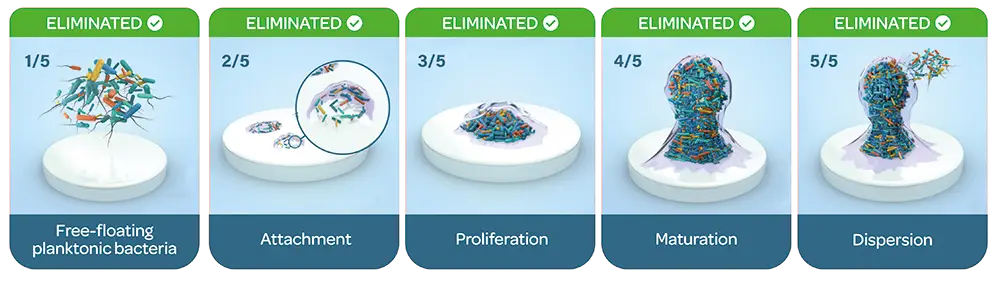
Tip: Do not assume continuous dosing products (that kill bacteria in stage 1) will mean no biofilm growth (stages 2-5) : AMR (antimicrobial resistance) means shock treatment protocols are still needed periodically.
Alternatively, you can use a weekly shock treatment, alongside bacteria free purified water the rest of the week.
Both protocols help ensure HTM01/05 and hence CQC compliance.
6. Waterline Compliance – Continuous Dosing vs Shock Treatment
Continuous dosing: low-level disinfectant continuously added; reduces biofilm formation and maintains microbial control. Only eliminates free floating bacteria (image 1 above)
Shock treatment: periodic high-strength disinfection to remove established biofilm, as found in stages 2-5 above. Involves leaving a disinfectant in the system (pipes, equipment, tank etc) for an extended period. Traditionally this involved toxic chemicals being left for 12 hours, with all disruption and risk mitigation that ensued. Until new technologies like Hypochlorous (HOCl), which achieve the same results in around 40 minutes, a whopping 90%+ time saving. The added bonus is HOCl is a non-toxic chemical, meaning next to zero risk for patients accidentally swallowing it , or dental nurses spilling it on skin or eyes.
7. Potable Water Systems – Risk mitigation
Effective potable water management combines design during the building stage, followed by monitoring during ongoing operations. L8 guidance recommends:
- Regular risk assessments
- Temperature monitoring
- Flushing routines
- Stagnation prevention
Good plumbing design reduces dead legs and ensures continuous flow, significantly lowering microbial growth potential. It is good practice to turn all taps on daily so as to ensure water is moving whenever possible, until point of use. Keep records of both potable and purified water monitoring in an easy to access file for CQC inspections.
8. Purified Water Sources
- Distiller kettles – simple but slow and energy-intensive-often filling decon rooms with steam.
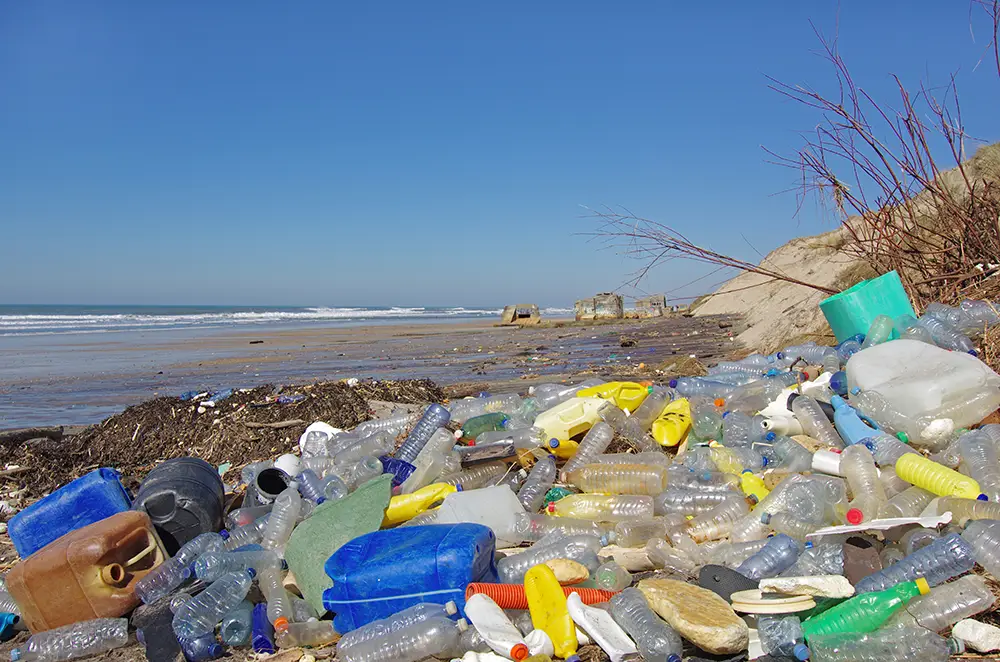
- Bottled DI water – convenient, but costly and storage-dependent. Also produces lots of unnecessary plastic waste.
- Reverse osmosis (RO) systems – continuous on-site production, low TDS, scalable. Often the best solution.
RO systems are increasingly preferred for their reliability, compliance, and operational efficiency.
9. Reverse Osmosis – Features & Benefits
Key Features:
- Nano filtration, making it ideal for dental equipment.
- Continuous automated water production
- Compact installation footprint
- Integrated monitoring
- The best RO take seconds to carry out maintenance (eg EauFlow).
- Exclusively used by the leading dental decon engineers and dental groups for over 15 years.
Practical Benefits:
- Protects autoclaves and washer disinfectors from scaling
- Provides consistent, high-quality water for cleaning processes
- Reduces handling and storage of bottled water
- Lowers electricity consumption (vs distillers)
- Simplifies compliance with HTM 01-05
Switching to RO – Key Considerations
“Failing to plan, is planning to fail” Benjamin Franklin – US forefather
Before installing an RO system, practices should:
- Assess purified water usage to ensure correct model is installed: this is done by counting up number of dental chairs and autoclaves in your practice
- Check water hardness for your area: hard or soft water model?
- Review plumbing layout in your decon room- do you have a clean water supply, free of dead legs in your building? Avoids TVC bacterial issues.
- Decide who will install the RO? Your usual decon engineer or do you want to use one of Tec-Safe’s recommended engineers?
Proper planning (water hardness, tank size, deciding dispensing types) with your practice’s specifications ensures seamless and uninterrupted usage with your autoclaves and dental chair waterlines.
Recommended services needed pre RO installation
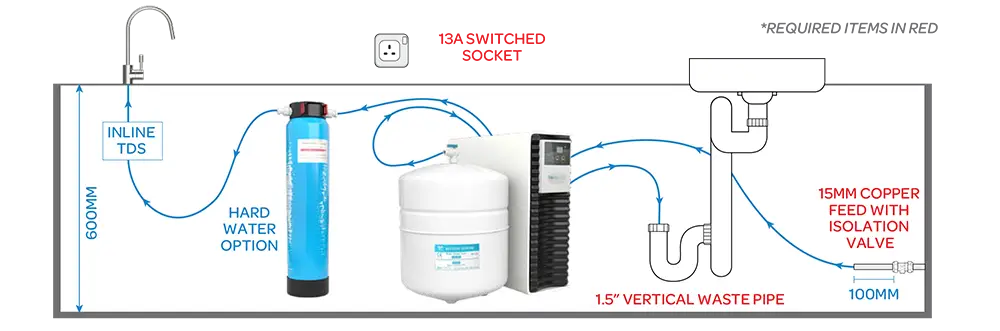
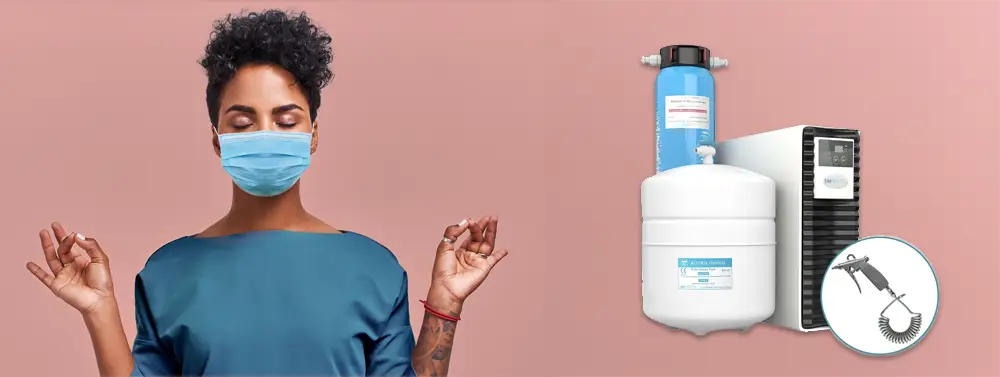
Eau-Safe RO – A H₂Olistic Approach
The Eau-Safe RO (Tec-Safe Ltd) is the culmination of 15 years of developing out the best features, to suit the needs of dental nurses and practice managers. Which is why it it is trusted by the leading decon engineers and dental groups.
Features:
- Built in TDS meters
- Quick-change cartridges across all 5 internal stages
- Hollistic approach to product support.
Benefits:
- Instant maintenance by any member of your practice’s team
- Eliminates equipment downtime issues in autoclaves and dental chairs
- Focus on delivering the complete solutions for practices
- Simplifies water management
- Supports regulatory compliance
Conclusion
Water may look simple, but in dentistry it is vital for safety, compliance, and efficiency. Differentiating between potable and purified water, monitoring TDS and TVC, managing biofilm, and using the best RO system ensures you are free to operate your practice unhindered.
Simon Davies is CEO of Tec-Safe, a UK based company that has specialised in water purification and disinfection for over 15 years. He is passionate about innovative products to help improve treatment outcomes, that eliminate dental biofilm faster and more safely than existing technologies.
References
- Walker JT et al. Microbial biofilm formation in dental-unit water systems. Applied and Environmental Microbiology.
- Wirthlin MR, Marshall GW. Biofilms and dental unit waterlines. Journal of Periodontology.
- Tuttlebee CM et al. Control of dental unit waterline biofilm contamination. Journal of Hospital Infection.
- Bayani M et al. Bacterial contamination of dental unit waterlines: systematic review. BMC Oral Health.
- Barbeau J et al. Biofilm formation in dental unit waterlines. Clinical Microbiology Reviews.
- Coleman DC et al. Microbial contamination of dental unit waterlines. Journal of Dental Research.
- Williams HN et al. Microbial biofilms in dental unit waterlines. Critical Reviews in Oral Biology & Medicine.